


Accelerating organizational understanding for a successful AI transformation
Executive summary
Your work is changing about twice as fast as it did three years ago. Your ability to see your own work has not changed since the 1990s. That gap is the problem, and it is widening: 25% in 2023, 66% in 2024, 116% in 2025, measured across more than a billion job ads.
You cannot slow AI down. You can only speed up your understanding of how your team uses it. Running your existing surveys more often will not do it, because those instruments do not capture the nuances of human intelligence, expertise, and judgment. What works is structured conversation at scale, on a cadence you govern.
Savo™ is the Human Intelligence Platform. Savo Signal Event™ interviews capture the reasoning of a workforce at scale and turn it into auditable, evidence-backed insight.
1. Two clocks
Every enterprise runs on two clocks. The work being done changes on the Work Clock. Your ability to see that work changes on the other — the Understanding Clock. AI has roughly doubled the speed of the first and left the second exactly where it was.
You do not set the pace of the Work Clock. The market does. But can you set the second one? How we see the work being done really hasn't changed in 30 years. The annual engagement survey assumes a yearly cadence. A job architecture on a two-to-three-year refresh assumes roles that persist through the global AI transformation. An eighteen-month skills taxonomy build assumes those skills will still be needed in 18 months.
None of those assumptions survives 2026. This is not a failure of effort or budget. It is a mismatch of measurement frequencies, and trying harder with the same legacy instruments will not close it.
2. The gap is widening
PwC's 2026 Global AI Jobs Barometer reads more than a billion job advertisements across 27 countries and territories, tracking how fast the skills an occupation requires change. Compare the most AI-exposed occupations against the least and you get one number.
|
25% 2023 66% 2024 116% 2025 Gap in the rate of skill change, most AI-exposed occupations against least. One source, one method, three consecutive years. |
The rate of change has more than quadrupled in two years. A company reviewing its job architecture every two years is now making leveling, hiring, and automation decisions about work it can no longer describe.
3. You cannot slow the Work Clock, nor should you want to
The same dataset shows what happens to firms whose work is changing fastest. Productivity growth of 34% in the most AI-exposed sectors, vs. 24% in the least. Headcount growth of 52% in the most AI-exposed sectors, vs. 36% in the least. There is a 62% wage premium for AI skills, up from 57% the year before. Suppressing fast-changing work is how firms lose productivity, growth, and talent at once. So the only viable alternative is to speed up the second clock.
4. Running your existing instruments more often makes it worse
The most obvious answer would be to run legacy instruments quarterly instead of annually. However, that's been shown to produce error faster, not insight faster. Three findings undercut the major classes of instruments enterprises use to read AI readiness.
- Researchers gave the same 514 people a self-assessment of their AI skills and an objective knowledge test, then compared the results in the AICOS validation study. The correlation was 0.04, which is statistically indistinguishable from no relationship at all.
- Key finding: how skilled people say they are with AI tells you nothing about how skilled they actually are. Every AI-readiness survey built on self-reporting has this problem.
- Stanford's WORKBank study asked 1,500 workers which of 844 real job tasks they wanted automated, and separately asked 52 AI experts which of those tasks AI can actually handle. The correlation was 0.17.
- Key finding: the two lists barely overlap. That gap is invisible to process-mining tools: feasibility shows up in system logs, but what people want automated doesn't. You have to ask them, and probe to get the full answer with full context.
- A 39-point gap between feeling and fact. In a randomized METR trial, experienced developers predicted AI tools would make them 24% faster. When measured, they were 19% slower. After living through it, they still believed they'd been sped up by about 20% — a 39-point gap between perceived and actual performance.
- Key finding: you can't survey your way to this truth. Only measurement catches it.
We went through the AI-transformation research published by Deloitte, EY, PwC, McKinsey, Bain, BCG, Accenture, and KPMG and pulled out every factor they identify as a determinant of success. There was consistent overlap on 24 of them, and on 14 of those 24, no measurement instrument exists anywhere. The firms agree these things determine success, and yet nobody can measure them with legacy methods. Among those not being measured: whether workers actually want a task automated, how much human oversight the AI ends up requiring, where the freed-up hours actually went, and whether people feel safe enough to experiment at all.
5. The instrument that works best has been there for forty years
In the personnel-assessment literature, the highest-validity single method against job performance is the structured interview, at r = .42. Self-assessment of ability comes in at .29, roughly 8% of variance. Skills inference from existing records has no published figure at all, which is worth knowing given where the biggest budgets in this domain go.
Enterprises did not choose the survey because it was better. They chose it because a structured interview needs a trained interviewer, an hour, and a scorer, and nobody could staff that across 20,000 people. That constraint is gone.
A Savo Signal Event interview runs an average of 10 minutes, voice-first, and captures roughly 1,325 words of structured reasoning where a survey item returns one data point. Four things make it measurement rather than a good conversation:
- The construct is defined before the question is asked, with explicit anchors for what counts as evidence. That is what makes a theme mean the same thing in two interviews.
- The interviewer does not score. A separate signal monitor tracks evidence against the standard and judges saturation live. In a clinical trial, the investigator and the monitor are different people for a reason.
- Evidence is gated. An AI without measurement science always produces an answer. The monitor decides whether enough came out to support a score, or whether it is withheld.
- Mode follows the question. Eliciting a memory, an attitude, and a demonstrated capability are different cognitive tasks. One mode per event, each grounded in a validated method.
Our validation: .59 mean convergent validity against established instruments the same participant completed in the same sitting, p < .001, with a .44 heteromethod correlation, so discriminant validity holds. Preference for the conversation over a survey moved from 53% to 77% after people took one. That is internal research, and we label it as such. No other AI-interview vendor has published validation studies.
6. A tool answers a question. A system runs a clock.
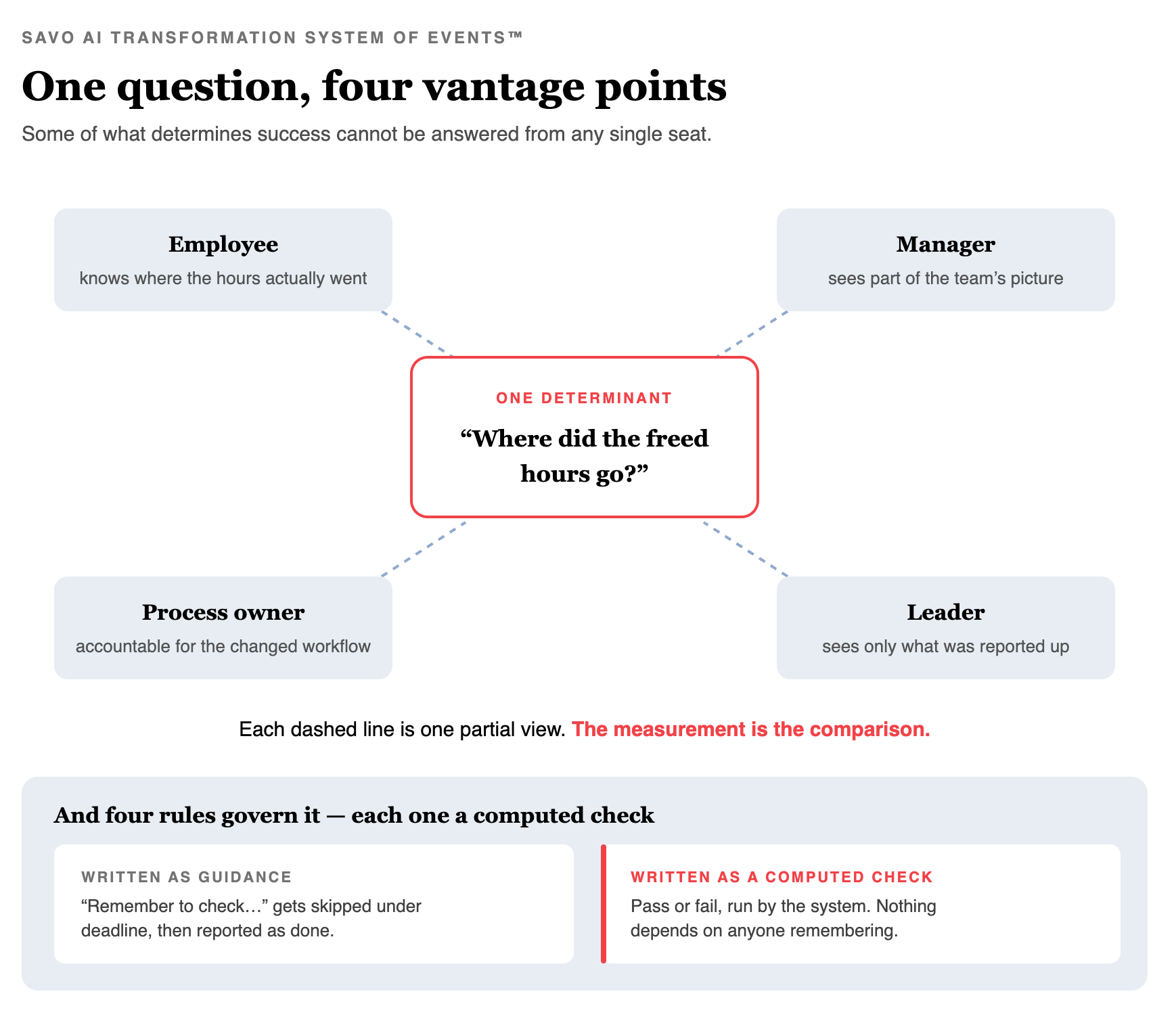
The Savo AI Transformation System of Events™ asks about the same transformation from four perspectives: the employee doing the work, the manager running the team, the person accountable for the process the work belongs to, and the leader who funded the change. Three of the success determinants the research agrees on can only be understood by comparing those perspectives. Four rules govern the system, and each is written as a check the system computes rather than a practice a person is asked to remember.
7. Where to start
Three events, one quarter.
- Work Composition & Waste. What the week is actually made of, and what to remove before you automate it.
- AI Oversight & Capacity Reinvestment. Gross time saved, minus oversight and rework, with the destination of the remainder named.
- AI Readiness Baseline. The population read that everything else gets measured against.
You cannot slow down AI. You can only speed up how fast you see and understand how your organization is adapting to it.
Get your personalized Savo AI Transformation System of Events™ plan.
Savo™, Savo Signal Science™, Signal Event™, Savo Event Studio™, Savo Session™, and Savo Insights™ are trademarks of Savo, Inc. The Savo logo is a trademark of Savo, Inc. All other trademarks and registered trademarks are the property of their respective owners. Savo is Patent-Pending